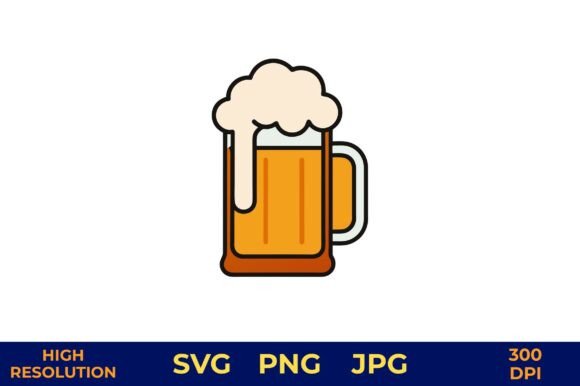
Beer Mug with Frothy Foam Vector Art
A Designer’s First Look: Lighthearted, Bold, and Instantly Recognizable
When I opened Beer Mug with Frothy Foam Vector Art, my first thought wasn’t “cute” or “fun”—it was “this will land.” The illustration leans into joyful exaggeration: a generously proportioned mug, foam spilling over the rim in soft, organic swirls, and warm golden tones that read clearly even at small sizes. It’s not hyper-realistic, and it shouldn’t be—this is graphic storytelling for makers who need charm *and* clarity. As an embroidery designer who’s stitched everything from nursery onesies to brewery merch, I immediately saw where this fits: custom totes for craft fairs, aprons for homebrewers, sweatshirts for dad-themed gift bundles, or even playful tea towels for a kitchen boutique.
How It Translates to Real Embroidery Projects
I tested Beer Mug with Frothy Foam Vector Art as the centerpiece of a custom embroidered canvas tote bag—something I’d sell in my own shop or recommend to an Etsy seller launching a “beer lover” collection. On medium-weight natural canvas with standard tear-away stabilizer, the design held its shape beautifully. The foam’s curves translated well into satin stitch outlines, and the mug’s rounded body gave enough surface area for smooth fill stitching without excessive density. It also worked cleanly on a lightweight cotton baby onesie (with cut-away stabilizer), though I scaled it down to 3.5 inches wide to keep proportions friendly for tiny garments.
Where it shines brightest is in context-driven projects: a holiday gift set with matching embroidered mugs and coasters, a wedding favor bag for a craft-beer-loving couple, or a patch for a homebrew club’s denim jacket. Because it’s delivered as a vector-based SVG alongside PNG and JPG files, resizing is lossless—critical when you’re adapting one design across patches, caps, and pillow covers. That flexibility makes it genuinely useful for small shop owners juggling multiple product lines.
Where to Use It Thoughtfully
Not every fabric or format suits this design equally. On stretchy knits like t-shirt jersey, I recommend reducing size slightly and using light- to medium-weight cut-away stabilizer—the foam’s delicate edges can blur if the fabric shifts mid-stitch. Dark fabrics demand attention to thread contrast: golden foam reads warmly against navy or charcoal, but avoid pale yellow thread on beige linen unless you want subtle texture over bold impact. And while the vector art is clean, avoid cramming it into hoops smaller than 4×4 inches—those foam swirls lose definition below ~2.75 inches wide.
Curved surfaces like baseball caps require extra care. I ran a test on a structured front panel and found the mug’s base flattened nicely, but the foam overflow needed slight simplification (a quick node edit in my digitizing software) to prevent puckering. Similarly, dense decorative accents—like adding a tiny hop vine border—should be evaluated separately. This isn’t an appliqué design; it’s a graphic illustration meant to stand alone with confidence, not compete with secondary elements.
What It Adds to Your Finished Product
Beer Mug with Frothy Foam Vector Art elevates handmade presentation without demanding technical gymnastics. Customers notice the warmth in the color story, the confident line work, and how clearly it reads from three feet away—whether on a market table or an Etsy thumbnail. That visual trust matters: buyers associate clean, intentional graphics with professional craftsmanship, even on budget-friendly items like kitchen towels or baby bibs.
For commercial embroidery, it supports brand consistency when used across product families—say, matching sweatshirt embroidery and embroidered patch sets for a local taproom. For digital product sellers, it’s a strong anchor asset: pair it with editable text layers or seasonal variants (pumpkin spice version, holly-trimmed winter edition) and you’ve got scalable design assets for your shop.
Practical Notes Every Embroiderer Should Check
- Test first—run it on scrap fabric matching your final project’s weight and stretch.
- Review thread colors before stitching—golden foam looks rich in rayon or polyester, but matte cotton thread changes the mood entirely.
- Inspect stitch density in the foam area; high-density fills may stiffen lightweight fabrics.
- Confirm hoop size and adjust scaling accordingly—don’t force detail into tight spaces.
- Check small details in black-and-white mockups; some screen-printed or printed versions lose nuance.
- Compare light vs. dark backgrounds—the transparent PNG works, but contrast shifts dramatically.
- Use proper stabilizer—especially for textured fabrics like burlap or terry cloth.
- Verify licensing before selling finished items or bundling the file digitally—this is a Graphics asset, not automatically cleared for resale.
Final Thought: A Reliable, Joyful Workhorse
This isn’t a trend-chasing novelty—it’s a thoughtful, reusable illustration built for real-world making. As a designer who’s turned down dozens of “beer-themed” files for being too busy, too literal, or too fragile in stitch, I appreciate how Beer Mug with Frothy Foam Vector Art balances personality with practicality. It invites smiles without sacrificing clarity, scales without breaking, and fits naturally into both personal embroidery projects and commercial craft business workflows. Whether you’re prepping for a holiday craft fair or building a cohesive line of custom apparel, this one earns its place in your folder of go-to Illustrations.