Beer Coaster Vector with Frothy Mug
A Designer’s First Look: Playful, Bold, and Ready for Real Fabric
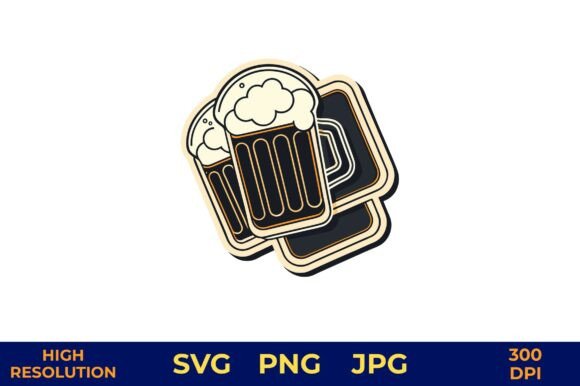
When I opened Beer Coaster Vector with Frothy Mug, my first thought wasn’t “cute” or “trendy”—it was “this will hold up.” The illustration lands with confident simplicity: a rounded coaster shape, a full mug tilted just enough to feel lively, rich foam texture implied through clean vector curves, and that crisp golden outline. It doesn’t try to be photorealistic—thank goodness—and it avoids clutter. That’s critical when you’re translating a digital graphic into thread. As an embroidery designer who’s stitched hundreds of beverage-themed motifs (from coffee beans to cocktail glasses), I immediately saw how this design would behave on fabric: bold at 3–4 inches, legible even in satin stitch, and forgiving on less-than-perfect hooping.
Where It Shines: Tote Bags, Aprons, and Small-Batch Merch
I tested Beer Coaster Vector with Frothy Mug as the centerpiece for a custom embroidered canvas tote—intended for a local brewery’s weekend pop-up. Stitched at 3.5" wide on medium-weight natural canvas with tear-away stabilizer, the golden outline popped cleanly, and the foam area translated beautifully into a soft fill stitch with subtle density variation. No bleeding, no puckering. It worked equally well on a cotton apron (using cut-away stabilizer) and as a standalone embroidered patch for denim jackets—especially when backed with iron-on fusible webbing first. For Etsy sellers or small shop owners, this is a reliable anchor design: it reads instantly, fits seasonal themes (think Oktoberfest, Father’s Day, wedding welcome bags), and pairs effortlessly with minimalist typography or monogrammed initials.
Why It Works for Personalized Gifts & Boutique Branding
Customers don’t buy “a beer mug.” They buy nostalgia, celebration, craftsmanship, or inside-joke charm. Beer Coaster Vector with Frothy Mug delivers that tone without leaning into cliché. Its clean lines and balanced negative space make it feel intentional—not clip-art. When stitched on a linen pillow cover or a waffle-weave kitchen towel, it elevates the item from “handmade” to “thoughtfully made.” I’ve seen too many craft businesses undermine their perceived value with busy, low-contrast, or over-rendered designs. This one avoids all those traps. It looks professional straight out of the hoop—no extra editing, no layering tricks needed.
Where to Pause: Texture, Scale, and Fabric Realities
That said, not every application is ideal. On stretchy fabrics like jersey or lightweight knits? Proceed carefully—even with proper stabilizer, the curved mug handle and tight foam swirls can distort if tension isn’t dialed in. On dark fabrics, test your thread colors: the golden outline needs warm-toned metallic or high-sheen gold thread to read clearly; standard yellow will disappear. And avoid using it under 2.5" on textured surfaces like terry cloth or heavy twill—it loses definition fast. Also note: while the vector file gives flexibility, the design wasn’t built for ultra-fine detail. Tiny lettering or intricate foam bubbles aren’t part of the original asset—so don’t expect them to embroider crisply. Keep it at its intended scale, and you’ll get clarity, not compromise.
Practical Notes Every Embroiderer Should Check
- Always test on scrap fabric first—especially if stitching on blends or new-to-you substrates.
- Review stitch density before finalizing: dense fills may overwhelm lightweight fabrics, while sparse runs risk looking thin on coarse weaves.
- Confirm hoop size compatibility: the design’s proportions suit standard 4"x4" hoops comfortably, but double-check before batching orders.
- Inspect small details in your embroidery software—look for stray nodes or overly tight corners that could cause thread breaks.
- Test black-and-white mockups to assess contrast and silhouette strength before committing to color palettes.
- Use appropriate stabilizer: cut-away for knits, tear-away for stable wovens, and water-soluble for delicate layers like baby onesies.
- Verify licensing before selling finished items or bundling the file in digital embroidery kits—this is a Graphics asset, not pre-digitized machine embroidery design.
Final Thought: A Versatile Asset, Not a One-Size-Fits-All Solution
Beer Coaster Vector with Frothy Mug isn’t flashy—but that’s its strength. It’s the kind of Illustration that becomes a quiet workhorse in your design library: dependable for custom apparel, charming on holiday gifts, and commercially safe for craft business use. It won’t replace a fully digitized machine embroidery design with optimized underlay or jump stitches—but as a starting point for applique design, printable mockups, or hand-drawn embroidery patterns, it’s refreshingly solid. If you're an Etsy seller building a cohesive line of bar-themed handmade products, or a small-batch decorator curating a summer collection, this is the kind of asset that saves time *and* raises perceived quality. Just remember: great embroidery starts with smart design judgment—not just pretty pixels.